
Low-code workflow platforms cannot deliver RFQ precision

Responding to Requests for Quotation (RFQs) and building accurate proposals is a time-consuming, complex workflow. It involves rapidly finding the right items in often large product catalogs, proposing substitutes or recommending complementary products, and taking customer specific contract terms into account. The speed and accuracy of this process determine whether you win the deal.
Many automation tools, such as n8n, try to solve the core data retrieval challenge using traditional Retrieval-Augmented Generation (RAG). As we mentioned in our last article, this approach is fundamentally insufficient for high-stakes tasks like RFQ automation.
Now we'll use a practical example to demonstrate where traditional RAG falls short and why a production-ready search system powered by agentic search is required to guarantee RFQ accuracy.
Setting the stage: IT provider RFQ
To demonstrate the critical difference between simple RAG and a production-ready search system, we'll walk through a common scenario for an IT provider. The task begins with an incoming RFQ from a client (significantly simplified for the purposes of demonstration):
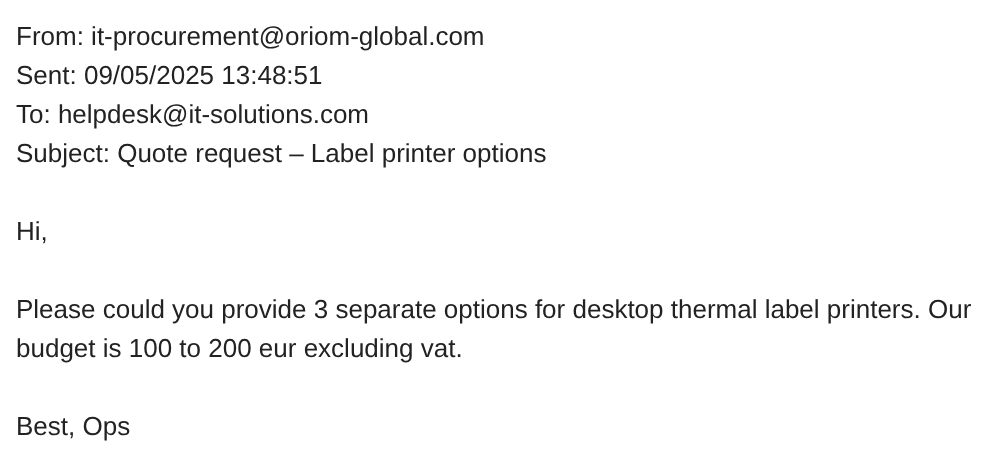
To fulfil this request, the automation system must search through the the company's product catalog to find three suitable products. While our illustration shows a catalog of around 6,000 products, in a real enterprise setting, this catalog could easily contain tens or even many hundreds of thousands of items, each with detailed descriptions, pricing, and stock status.
The system must perform an intelligent search across this combination of structured and unstructured data:

Where traditional RAG falls short: an example with n8n
To demonstrate the precision gap, we examine a typical RAG implementation in a low-code tool (n8n).
The workflow relies on a Load Data Flow where the large product catalog must be chunked and embedded. Even for our 6,000-product example, this quickly strains their cloud plans, forcing enterprises into complex external vector store setups (like Qdrant)—which defeats the promise of low-code simplicity.
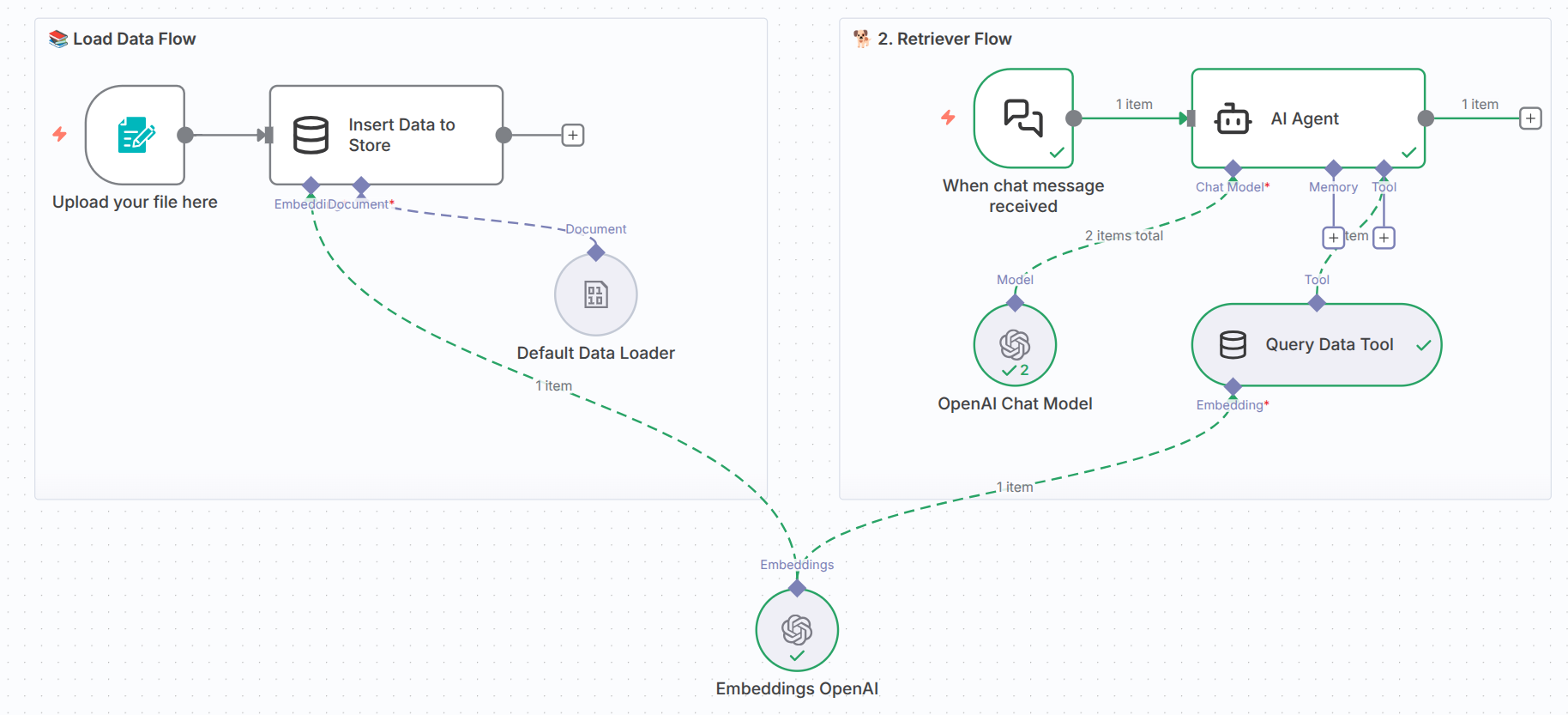
The system then uses the semantic search in the Retriever Flow to process the RFQ. It looks for conceptually similar items in the catalog based on the text query "desktop thermal label printers under 200 euro plus vat”.
When the RAG system executes the query, it retrieves products that are conceptually similar but ignores the critical budget limit.
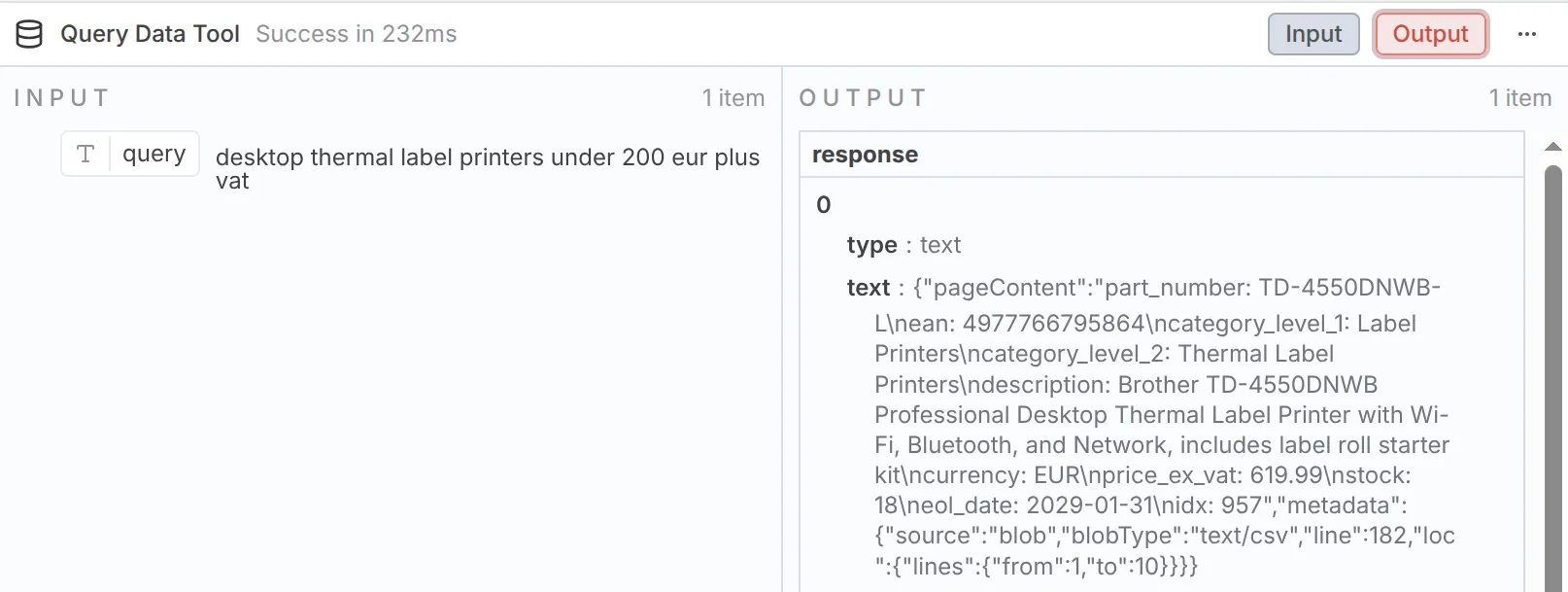
The products retrieved are all models of the Brother TD-4550DNWB printer, with prices starting at €619.99, well outside the €100 to €200 budget!
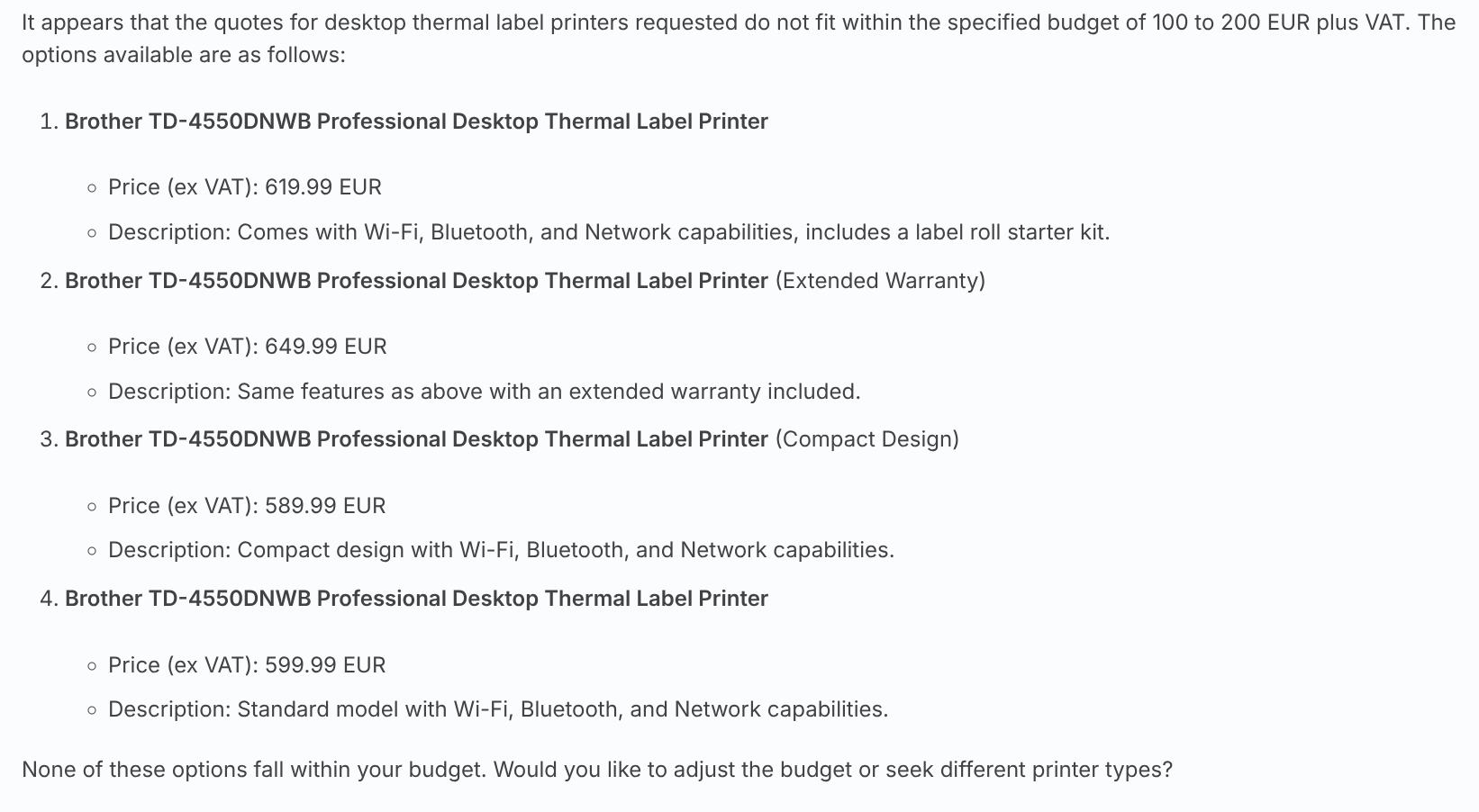
The RAG system fails because it treats the rich, filterable data (price, stock, EOL date) as flat text. Semantic search prioritizes conceptual similarity (e.g., "desktop thermal label printer") over the precise filtering constraints (e.g., price range). The fundamental flaw results in an inaccurate retrieval. The deal is already lost at the first hurdle, finding the right products.
Guaranteed precision: the power of agentic search
Decision computing eliminates the need for manual RAG pipeline construction, external vector stores, and brittle database connections. Instead, the process is consolidated into a simple workflow:
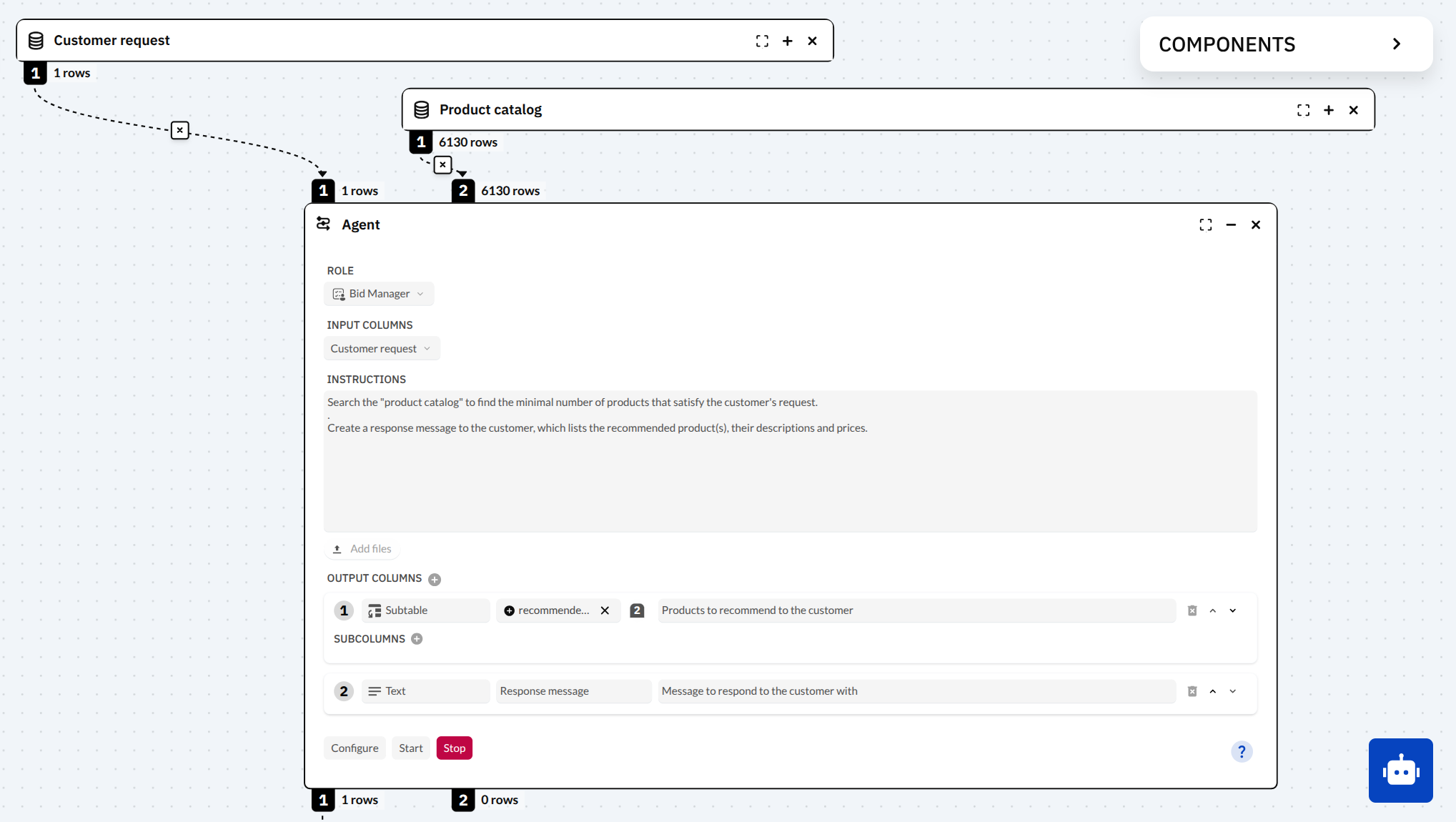
The Agent acts as a sophisticated query orchestrator. It intelligently separates the core search intent from precise filtering requirements (like budget), using powerful hybrid search to guarantee retrieval precision across all enterprise data types. This hybrid approach leverages semantic, full-text, and advanced SQL queries across structured catalogs, unstructured documents, images, audio, and video - handling the messy reality of enterprise knowledge.
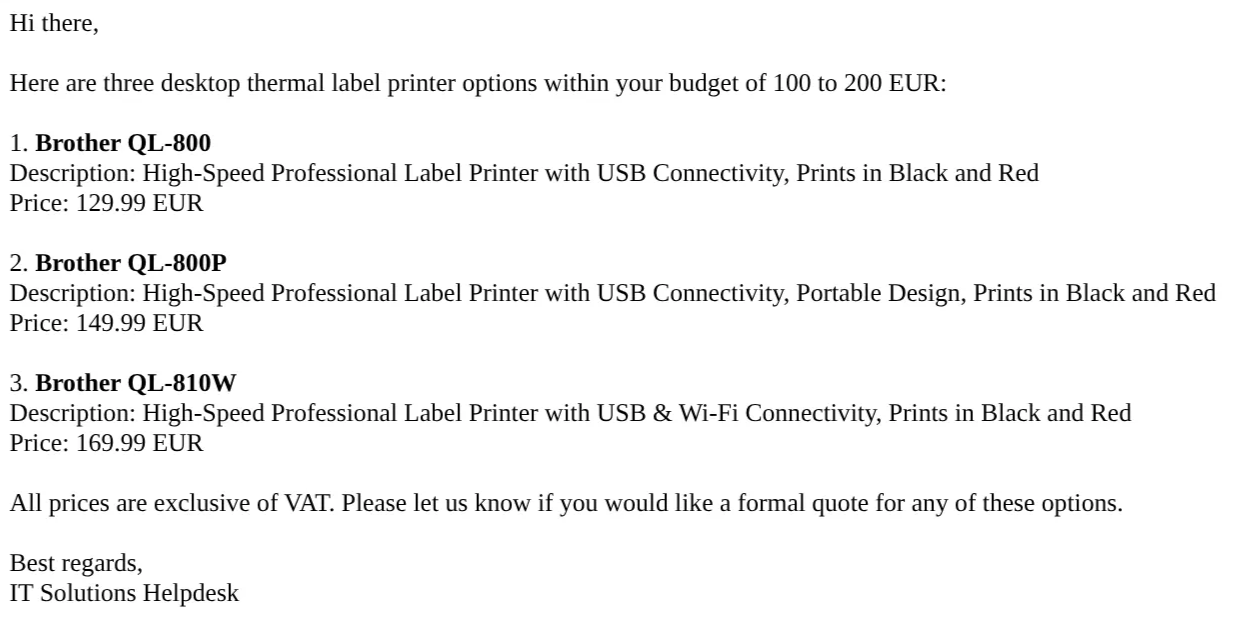
The result is a prompt and accurate response:
Creating a winning quote 🥇
Our demonstration proves that a basic RAG setup is insufficient for high-stakes workflows like RFQ automation, whilst our agentic search platform orchestrates and completes the full, multi-stage workflow. After finding the requested items, the workflow also applies further steps to ensure:
- Contract Compliance: Searches unstructured documents for customer-specific contract terms.
- Dynamic Discounting: Applies real-time, customer-specific discounts and special agreements.
- Cross-Selling: Intelligently finds substitutes or complementary products.
- Finalization: Assembles all data and generates the final quote response using a bespoke template.
Our platform handles this in one simple, continuous workflow, giving winning quotes in record time.

Want to handle RFQs at enterprise scale in seconds?
Deploy a production-ready search system to free your team to deliver value, not chase data.

Legal
Privacy policyGet the latest product news and updates.